Muay Thai Ankle Injuries: How to Rehab Them and Get Back to Kicking
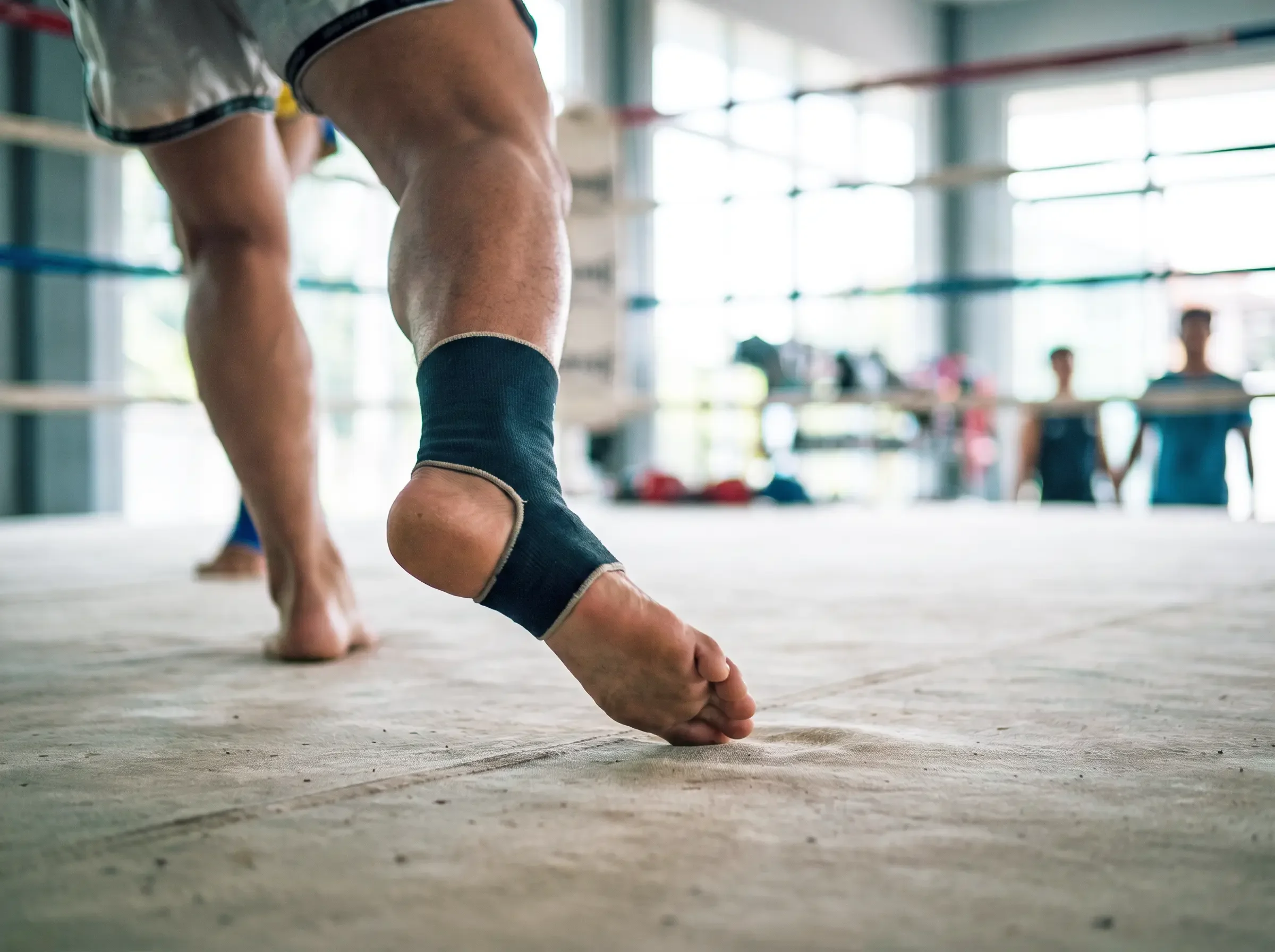
Ankle sprains are one of the more common injuries in Muay Thai, and one of the most commonly under-treated. Most people ice it, tape it, and hobble back to training too soon. Then they sprain it again. And again.
Research consistently shows that once you sprain an ankle, your risk of re-spraining it sits at around 70% or higher if you don't address the underlying instability. In Muay Thai, where you're pivoting, kicking, checking, and moving on a single leg constantly, an under-treated ankle will come back to haunt you.
Here's what actually drives recovery, and what a proper return to training looks like.
Medical Disclaimer: The information in this blog is intended for general educational purposes only and does not constitute medical advice. It is not a substitute for professional assessment, diagnosis, or treatment by a qualified health practitioner. If you are experiencing pain, have sustained an injury, or are unsure whether it is safe to continue training, seek assessment from a qualified physiotherapist or medical professional.
Why Muay Thai is particularly demanding on ankles
Most gym sports happen in shoes, on flat surfaces, with relatively predictable foot placement. Muay Thai training is barefoot, on mats that vary in grip, with frequent single-leg loading during kicks, pivots, and level changes. Checking a hard leg kick puts massive instantaneous force through the outside of the ankle. Landing awkwardly from a knee or a missed kick can roll it in a fraction of a second.
The same ankle that feels fine walking around can be completely underprepared for checking a low kick in the third round of sparring.
Types of ankle injuries in Muay Thai
Lateral ankle sprain (most common) The classic rolled ankle. Usually caused by landing awkwardly, missing a kick and catching the edge of a pad, or an opponent catching a kick at an awkward angle. The lateral ligaments (ATFL, CFL) take the load. Grades range from minor stretching to partial or complete tears. The vast majority don't require surgery, but all grades benefit from proper rehab.
High ankle sprain (syndesmosis) Less common but more significant. Involves the ligaments holding the two lower leg bones together. Often happens from a rotational mechanism - a twisted landing or a caught kick. These take longer to heal and are frequently under-diagnosed because the initial swelling and pain can seem similar to a standard lateral sprain. If you "sprained" your ankle and it's not settling the way it normally would, get it properly assessed.
Peroneal tendon injuries The peroneal tendons run along the outside of the ankle and are crucial for the lateral stability you need when kicking and pivoting. They can be strained or subluxed (flick out of their groove) from a forceful ankle roll. Commonly misdiagnosed as a straightforward sprain.
Why "rest and ice" isn't enough
RICE (rest, ice, compression, elevation) has its place in the first 48 hours, primarily to manage swelling and protect the tissue from further damage. But the research has moved on significantly. Prolonged rest actually slows recovery by reducing the mechanical stimulation the tissue needs to heal properly, and it doesn't address the neuromuscular deficits that make re-injury so likely.
After the acute phase, what drives recovery is progressive loading and balance retraining - teaching your ankle and the muscles around it to respond correctly again under the specific demands of Muay Thai.
What return to Muay Thai training actually looks like
Timeframes vary a lot between two people with the same injury, so the return is staged against what the ankle can actually do rather than how many weeks have passed. The rough ranges below are a guide, not a schedule.
The Combat Ready System
Assess
Swelling management, gentle range of motion and protected weight-bearing as tolerated. We work out what is injured and what you can still train safely. Most nak muay keep working punch technique, clinch entries and shadowboxing in a stable stance from the first week. You are managing the injured structure while keeping everything else moving, and you leave with a written plan.
Rebuild
Progressive single-leg balance work, calf and peroneal strengthening, and sport-specific movement reintroduction. This is where self-managed rehab usually stops short: a few calf raises and a declaration of readiness. The ankle needs loading through the ranges and speeds Muay Thai actually demands. Typically the two to four week window.
Return
Pad work with modified footwork, drilling combinations without heavy pivoting, light bag work. Progression runs on objective criteria: a single-leg balance with eyes closed for 30 seconds, 10 hops on the affected ankle without pain or instability. You move forward when you hit the benchmark, not when the calendar says so. Often around four to six weeks.
Perform
Checking, full combinations and sparring are the last stage, not the first test. By this point the ankle has demonstrated stability under progressive loading rather than just feeling fine walking around. Ongoing ankle stability and conditioning work is what stops the same sprain happening again.
What you can usually still train
A moderate Muay Thai ankle sprain rarely means shutting everything down. Here's what you typically can still do:
Shadowboxing on two feet, limited pivoting
Upper body pad work in a stable bilateral stance
Clinch entries and defence (seated or standing without footwork)
Bag work with reduced kicking on the affected side
Upper body conditioning and strength work
Core work, skipping (once swelling settles and loading is tolerated)
Staying in the gym - doing what's safe - keeps your cardio base, your sharpness, and your mental state intact. Sitting on the couch for six weeks is rarely necessary and often counterproductive.
Common Questions
How long before I can kick again after an ankle sprain?
It depends on the grade and the structure involved. A minor lateral sprain and a high ankle sprain sit a long way apart. What matters more than the week number is whether the ankle passes the criteria for each stage: single-leg balance, hopping without pain or instability, then loading through the ranges Muay Thai actually demands. You progress when you hit the benchmark.
Can I still train Muay Thai with a sprained ankle?
Usually yes, in modified form. Punch technique, clinch entries and defence, upper body pad work in a stable stance and conditioning are often available from early on. Shutting everything down for six weeks is rarely necessary and costs you conditioning and sharpness you then have to rebuild.
Why does my ankle keep rolling?
Repeated sprains usually point to unresolved deficits from the first one: reduced balance and position sense, weakness through the peroneal muscles, or loss of ankle mobility. Those don't resolve on their own with rest. They need to be found and specifically loaded, which is why an ankle that feels fine walking around can still fail under a checked kick.
Should I tape or brace my ankle for training?
Taping and bracing can help during the return phase, and many nak muay keep using them for sparring afterwards. They support the ankle while the underlying strength and control are being rebuilt. They're a support to rehab, not a replacement for it.
Do I need a referral to see a physio for a Muay Thai injury?
No. Physiotherapists are first-contact practitioners in Australia, so you can book directly without a GP referral. You only need one if you're claiming through a Medicare care plan, DVA, or a workplace scheme.
Related Reading
Muay Thai shin pain: conditioning, injuries and what to do about it
Why "just rest" is the worst advice for combat athletes
How long do combat sports injuries take to heal?
Ready for a plan?
If you've rolled your ankle at training and want a clear path back to full Muay Thai, kicking, checking and sparring, without the guesswork, we can help. Combat Sports Consulting works with Muay Thai athletes in Melbourne in-clinic, and online anywhere in Australia.
If you are dealing with an ankle injury and you are not sure what is safe to train, book an initial consult. It is a free 15-minute call, no cost and no obligation, to work out whether we are the right fit and what your next step should be.